
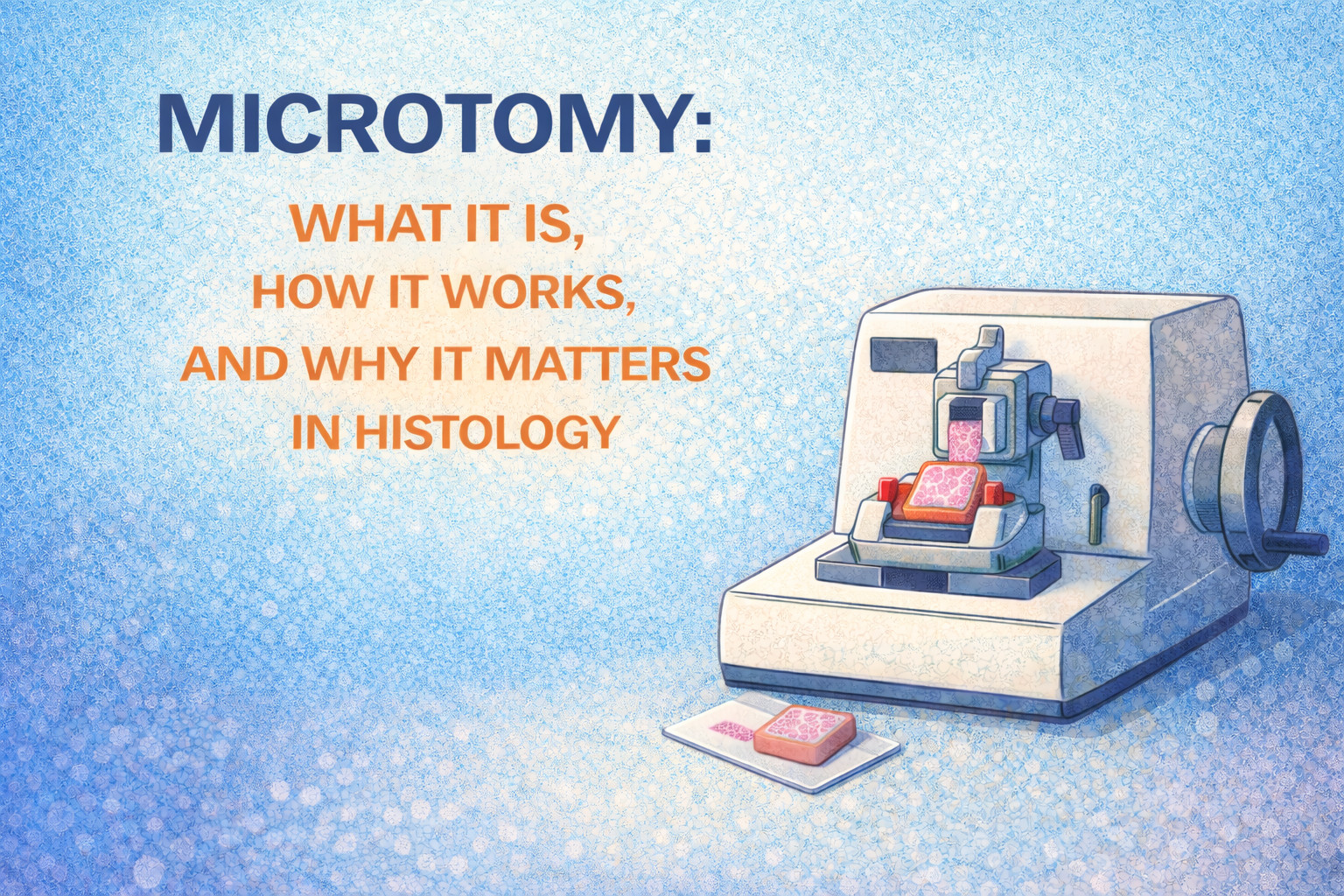
Microtomy is the process of cutting extremely thin tissue sections for microscopic examination. It is a foundational technique in histology, pathology, and biomedical research, allowing tissues to be prepared for staining and diagnostic evaluation.
This guide explains what microtomy is, how it works, what equipment is used, and why proper microtomy technique is essential for accurate diagnosis and high-quality slide preparation.
What Is Microtomy?
Microtomy is the controlled slicing of biological tissue into very thin sections — often between 3 and 5 micrometers thick — using a precision instrument called a microtome.
These thin sections are mounted onto glass slides, stained, and examined under a microscope to evaluate tissue structure, cellular morphology, and disease processes.
Microtomy is used in:
- Clinical histology laboratories
- Pathology departments
- Research laboratories
- Veterinary and forensic labs
How Microtomy Works
Microtomy involves several key steps:
- Fixation — Tissue is preserved to prevent degradation.
- Processing — Tissue is dehydrated and infiltrated with paraffin or frozen.
- Embedding — The tissue is supported in a block (usually paraffin).
- Sectioning (Microtomy) — Thin sections are cut using a microtome.
- Mounting — Sections are placed on glass slides.
- Staining — Tissue is stained for contrast and visualization.
Each step must be carefully controlled to preserve tissue integrity and diagnostic accuracy.
Types of Microtomy
Different forms of microtomy are used depending on tissue type and application:
Paraffin Microtomy
Used for routine histology. Tissue is embedded in paraffin wax and sectioned at room temperature.
Cryo-Microtomy (Frozen Sectioning)
Performed at low temperatures using a cryostat for rapid intraoperative diagnosis.
Resin Microtomy
Used in research and electron microscopy for ultra-thin sections.
Microtomy Equipment
The primary instrument used in microtomy is the microtome. Common types include:
- Rotary microtomes
- Sliding microtomes
- Cryostats (for frozen section microtomy)
- Ultramicrotomes (for electron microscopy)
Supporting equipment includes:
- Disposable or reusable microtome blades
- Water baths
- Slide warmers
- Staining systems
Why Microtomy Is Critical for Diagnosis
Accurate microtomy ensures:
- Uniform section thickness
- Minimal tissue distortion
- Proper orientation of tissue
- Clear microscopic visualization
Poor microtomy can result in:
- Torn or compressed sections
- Inaccurate staining
- Diagnostic artifacts
- Misinterpretation of tissue pathology
High-quality microtomy is therefore essential for reliable pathology results.
Common Challenges in Microtomy
Histology labs often encounter challenges such as:
- Wrinkled or folded sections
- Knife marks or chatter
- Tissue compression
- Difficulty cutting hard or fatty tissues
- Blade dulling or damage
Proper equipment, blade selection, and technique are key to minimizing these issues.
Who Performs Microtomy?
Microtomy is typically performed by:
- Histotechnologists (HT/HTL)
- Pathology laboratory technicians
- Research technicians trained in histology
Training, experience, and proper equipment all contribute to consistent results.
Final Thoughts
Microtomy is a precise and essential process in histology and pathology. It transforms preserved tissue into analyzable microscopic sections that enable accurate diagnosis, research, and understanding of disease.
Understanding the principles of microtomy, the equipment involved, and best practices helps ensure high-quality slides, reliable diagnoses, and efficient laboratory workflows.